
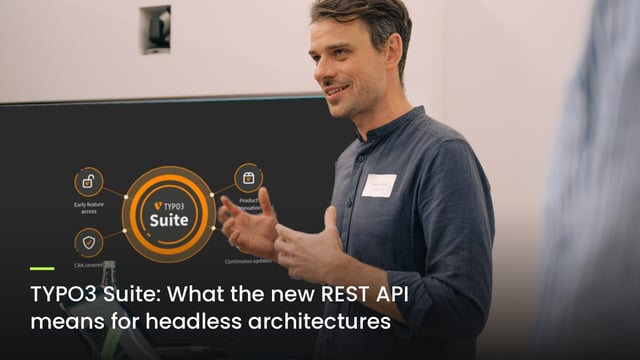
The TYPO3 Suite has been available for order since November 2, 2026. At first glance, it’s a commercial add-on package for an open-source CMS. But upon closer inspection, it represents a strategic decision that’s relevant for companies using TYPO3 and for anyone considering a headless approach.
As a TYPO3 Solution Partner, we’ll break down what the Suite is, what it isn’t, and who it’s worth it for.
What is the TYPO3 Suite?
The Suite is a commercial repository maintained by TYPO3 GmbH. It delivers selected features earlier than the regular release cycle. Until now, major new features were only released every 18 months with the next LTS version.
Important: The Suite is neither a fork nor a closed enterprise version. TYPO3 CMS remains free and open source. Features from the Suite may be incorporated into the core at a later date.
The package includes:
- early access to new feature extensions
- up to seven years of support per Suite version
- Extended Long-Term Support (ELTS) for supported versions for the duration of the subscription
- manufacturer liability by TYPO3 GmbH in accordance with the EU Cyber Resilience Act
The suite is available exclusively through official TYPO3 partners.
Why is the REST API actually the most exciting feature?
The first feature of the suite is a REST API, available starting November 9, 2026. Next on the roadmap are a WYSIWYG editor and an MCP server.
The order says a lot. An official API maintained by the vendor is a prerequisite for TYPO3 to deliver content cleanly to other systems: to its own front end, to apps, to product portals, or to AI applications. That is precisely the core of headless.
Until now, Headless with TYPO3 has mostly run via community extensions. That works, but it shifts maintenance and responsibility to the individual project. With the Suite, the interface comes directly from the vendor.
The announced MCP server takes it one step further. MCP is an open standard through which AI assistants access systems. A CMS with its own MCP server thus becomes a data source for AI applications.
When is TYPO3 a good choice as a headless backend?
Headless is not an end in itself. A decoupled front end offers freedom, but it also means a second codebase that needs to be built and maintained. Our rule of thumb:
A headless setup with TYPO3 is worthwhile if
- Content is delivered across more than one channel, such as a website, product portal, and app
- the front end has higher performance or interaction requirements than a traditional template can deliver
- TYPO3 is already established, the editorial workflow and permissions structure are functioning well, and switching systems would be disproportionately costly
It’s probably not worth it if
- it involves a single website without any other channels
- no one on the team can maintain a separate front end on a long-term basis
- a fresh start with a native headless CMS is on the horizon anyway
To be honest: The REST API is still in its early stages. How far it will go in complex projects will become clear in the coming months. We’ll be testing it and reporting back.
What changes will the Cyber Resilience Act bring?
The EU Cyber Resilience Act (CRA) requires manufacturers of digital products to address security vulnerabilities, provide security updates, and maintain documentation, among other things. The reporting requirements have been in effect since September 11, 2026, and the essential requirements take effect on December 11, 2027.
With the Suite, TYPO3 GmbH assumes the role of manufacturer for maintained LTS versions and all Suite components. This provides clarity, but it doesn’t solve everything. Agencies and companies remain responsible for their own code, custom extensions, and integration into the project.
Anyone from the industry is familiar with the principle of their own product: Responsibility can be shared, but not relinquished. It must be clearly distributed.
Who stands to benefit from the Suite?
According to the vendor, the Suite costs €12,000 per year and per instance, plus VAT; one development instance is included. It’s particularly worthwhile in three scenarios:
- You’re running an older version of TYPO3 and need ELTS while the upgrade is in progress.
- You want to deliver content headless or for AI applications and rely on a vendor interface to do so.
- You need a clear chain of responsibility for your CMS when it comes to CRA.
If none of these apply, TYPO3 CMS without the Suite remains a solid choice.
Our Assessment
The Suite makes TYPO3 faster and provides greater regulatory clarity. For us, the most important point is the direction: TYPO3 is officially opening up to headless and AI. For companies, the question is no longer whether their CMS can deliver content to other systems, but how well it can do so.
We don’t decide which architecture is right for you based on the tool, but rather on your channels, your team, and your goals. Get in touch with us.
FAQ
Does TYPO3 stay free?
Yes. TYPO3 CMS remains open source. The suite is an additional, paid offering.
Do I need the suite for headless?
No. Headless with TYPO3 is also possible through extensions. The suite provides the interface from the manufacturer, including support and manufacturer responsibility.
Which versions does the suite apply to?
For the current LTS versions TYPO3 v13 and v14. ELTS for older versions is included as long as the subscription is active.
How do I get the suite?
Only through official TYPO3 partners. SUNZINET is a TYPO3 Solution Partner.


Written by
Sebastian Spill
Chief Technology Officer
Sebastian Spill is CTO at SUNZINET and heads the agency's largest unit. With more than 15 years of agency experience, he is responsible for web development, platform architecture and complex integration projects across industry, retail and financial services.